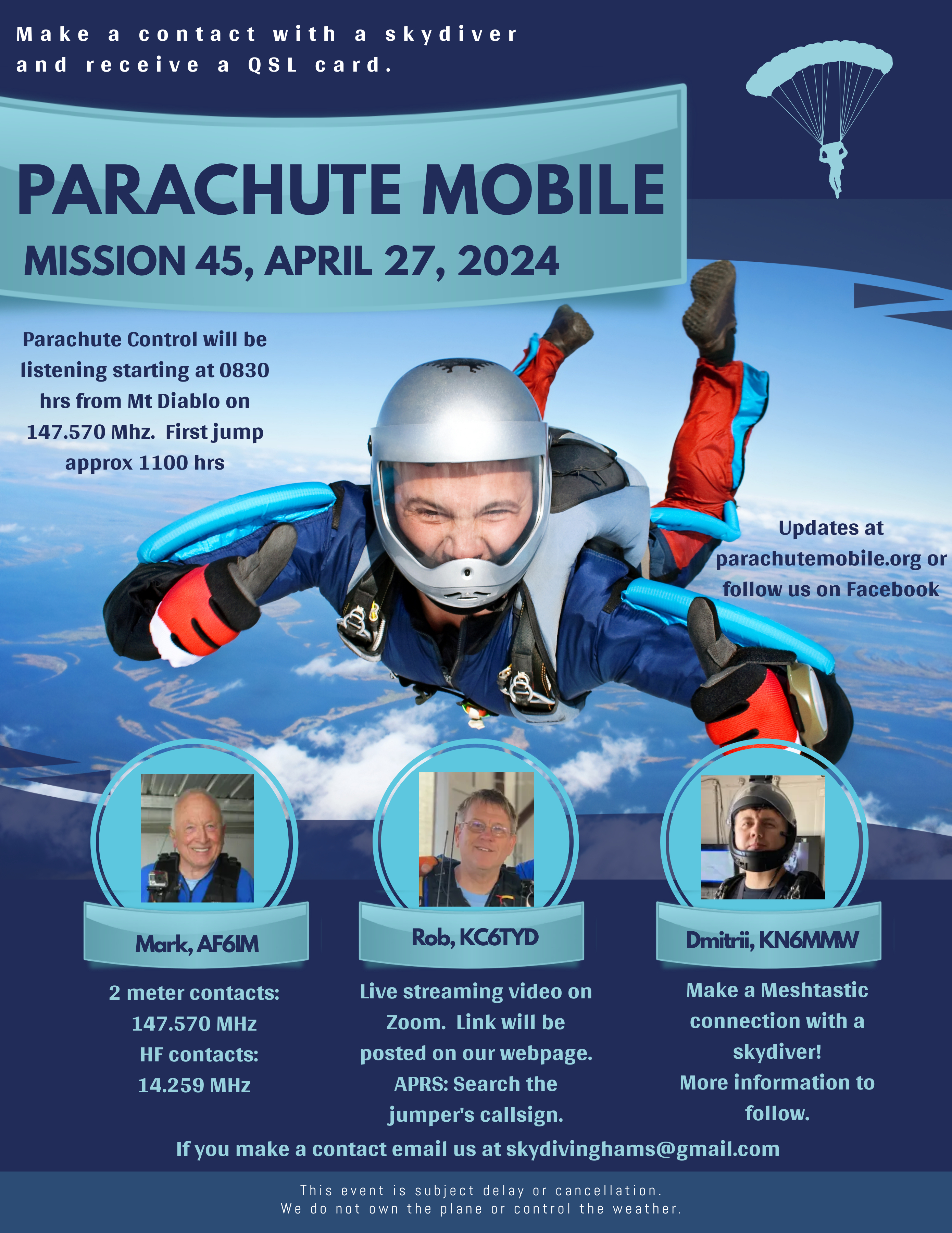
Mission 10 – Radiofest March 3, 2012

We hope to have our first jump as close to 12:00.pm as possible We anticipate a total of three jumps about an hour apart. Starting around 10:00 .am. we will make periodic QSTs on the Radiofest talk-in frequency of 146.970- 94.8, with updates and expected jump times. Before each jump you will want to tune in on 146.430 simplex to make the actual contact. A ham station will be available at our booth at Radiofest in the event you don’t have a radio. You can also watch each Jumper on APRS.FI. Search the call signs AF6IM (Jumper 1) and KF6WRW (Jumper 2). We will also be streaming live video on Justin.TV at http://justin.tv/kf6wrw.com.

The Drop Zone will be at Marina Airport. Feel free to come out and watch the action first hand. But PLEASE, no one is permitted to enter through any restricted entrances and especially onto the airport runway.


MIssion 9 – Jim Wilson Images

Jim is a friend of Mark, AF6IM.  He is a Captain in the Royal Canadian Air Force and serves as a navigator/radio operator on C 130 rescue aircraft.  Jim holds the Canadian record for the most jumps in a 24-hour period, 200 jumps in a bit over 12 hours. He is a rigger and skydiving instructor whose hobby is collecting, restoring and jumping classic and antique parachutes.

http://www.metronews.ca/ottawa/canada/article/287803–skydiver-aims-high-for-charity

He has a cool setup for his helmet cam which uses a bite switch for triggering the shutter. This keeps his hands free for maneuvering his chute. I’ll get a gallery going later.  But here is an image to get you excited about other images Jim took on Parachute Mobile mission 9.


Mission 9 – Pacificon – Videos

We had a lot of video captured during this mission.  Michael Gregg, KF6WRW did am amazing job pulling his helmet cam together.  Michael Wright, K6MFW, was there with 2 cameras.  Jim McCarthy, K6BBA, took a lot of video around Pacificon.  Mark Meltzer, AF6IM, was interviewed by Leo Laporte, W6TWT.

Leo Laporte – The Tech Guy 814 – Pacificon

Mark, AF6IM, was interviewed and they were talking about parachute mobile from minutes 8:51 to 12:50

Michael Gregg, KF6WRW

Michael spent months working on how to get video from the sky to the ground.  He wound up with a small camera he mounted to his helmet using a custom bracket and a part made on a Markerbot 3D printer.  He ran the video cable down to his foot where he had a 2W 2.4Ghz transmitter. He then had 2 patch panels antennas connected to the receiver.  The dual patch panel was an idea from a co-worker of mine Antonio Forenza, KE5MRG.

2.4Ghz Diversity Receive Antenna

The helmet camera

Michael Wright, K6MFW, took a series of screen shots from Michael Greggs’s video.

Click here to see Michael’s screen captures

Michael Wright, K6MFW

Michael also did some screen captures from his videos show the setup at the drop zone.

Click here to see the screen captures

Jim McCarthy, K6BBA


Robins Images

Robin, KI6TYA, is a member that participates where she can.  She is in participating in as many activities as she in between going to school.  Her participation is always appreciated.  She took a bunch of pictures with her phone.  Here is the gallery.


Mission 9 – Mark, Jumper 1′s Perspective

Mark, AF6IM, is Jumper 1. Mark loves seeing how we pull technology together and how we all work well together. You get a lot of cooperation for a Ice Creme cone :-D

Mark Gearing Up for His Jump

This whole Parachute Mobile concept started so simply, I (Mark Meltzer AF6IM) and Michael Gregg KF6WRW met on the N6NFI repeater in 2008 and learned that we both shared an interest in ham radio and skydiving. We originally envisioned jumping with hand held radios (HTs) and just calling out on repeaters, but when we talked about it among other hams there was a keen interest in expanding our concept and the Parachute Mobile Project was born.

Today we have over a dozen dedicated hams on our team and the project has grown to include voice comms, navigation and physiological radio telemetry, HF PSK 31 beaconing, live 2.4 GHz amateur television from aloft, and much more.

Our team especially enjoys Parachute Mobile missions that are coordinated with nearby hamfests. Hamfests are conventions or meetings of ham radio enthusiasts and draw a big crowd from a wide geographical area. Pacificon is an ARRL sanctioned event put on by MDARC (Mt Diablo Amateur Radio Club) and draws over a thousand hams to a SF Bay Area location every fall.  The 2011 Pacificon event was scheduled for the weekend of October 15 at the Santa Clara Marriott.  Although the jumpers would like to jump into the actual hamfest sites, their dense urban locations raise too many safety and FAA issues so we opted for jumping at a nearby dropzone (DZ) and having a manned display at the convention site with operators, video and telemetry data displays and voice comms.  We also set up a “parachute control” station on a mountain peak (Mt. Diablo) bridging the DZ with the convention site located on the other side of a mountain range.

We performed several practice missions at the Byron CA DZ to be sure that we had all the bugs worked out for the Pacificon jumps. There are so many things that can go wrong with airborne jumper carried video, telemetry and voice comm gear, ranging from power connections, antenna mounts and leads, conflicts with the parachute gear, etc. Amazingly we got it all worked out. Our Data Dude, Mikey NE6RD, even got a home brew wireless weather station set up on the DZ to give us second by second wind and other weather data using an enhanced Bluetooth radio link to the command center at the DZ.

When Saturday morning October 15th rolled around, various team members deployed to Pacifcon, Mt Diablo and the DZ at Byron. The weather was perfect, clear skies and light winds. Michael Gregg KF6WRW and RCAF Capt. Jim Wilson, our camera flyer made the first jump from 13,500 ft. We were all literally holding our breath to see if the live video from Michael’s 2.4 GHz setup would work. There were a lot of whoops and high fives at the DZ command center when clear video was received and Michael called the DZ saying that his safety checks were complete and that he was ready for Pacifcon QSOs. Michael Wright, K6MFW, who is a very experienced skydiver and ATV enthusiast, had all sorts of video gear set up and was displaying and recording the video from the ground and from the jumper.  Team Coordinator Rob Fenn KC6TYD at the DZ command center handed off KF6WRW to Darryl Presley KI6LDM at parachute control on Mt Diablo who cleared the jumper for QSOs and the fun began.

At 13,000 feet the radio coverage area is huge and what might sound like a clear channel to one ham on the ground sounds like a big pileup to the jumper as hams from a hundred mile radius compete for a QSO. KF6WRW sorted it out and made a number of Pacificon QSOs and also with hams in other communities as far away as Sacramento. The Pacifcon attendees were thrilled to see live video from Michael’s camera sent to the DZ on 2.4 GHz and relayed to the convention site over Justin TV, an Internet streaming link. Jim Wilson was flying a unique pink colored high aspect ratio canopy known as Pink Floyd. Pink Floyd has an incredible glide ratio and speed range which allowed Jim to literally fly circles around Michael to get good still camera photos. At one point Jim dragged his feet across the top of Michael’s canopy to get a close shot as he came off the other side.

On the next jump Michael Gregg and I jumped together. As my chute opened I started making my safety checks, especially looking for damage to the canopy or the suspension lines that might necessitate a cutaway. Everything was shipshape but I delayed my “safety checks complete” call to allow a brief frequency excursion to the N6NFI repeater to accommodate a request from a ham in the UK to make a Parachute mobile contact. I had to take my HT out of its harness pocket and select a different frequency from the Pacifcon channel. I prayed that I wouldn’t drop the HT while changing channels.

Pink Foster KG6ILA, Jon Gefaell K6OJ (a Parachute Mobile co-founder) and Andy Korsak KR6DD all helped out to make the UK QSO happen. Echolink, an Internet voice service for hams, would allow the UK ham to use N6NFI for a contact with me. The voice packets would route through K6OJ’s Echolink node in Hayward CA which was being controlled by Pink in Tucson AZ.  It was a dazzling mish mash of radio and Internet technology and it all worked, well almost. Pink answered immediately when I made my initial call on N6NFI from about 13,000 feet and had been recently in contact with Ian, the UK ham. Unfortunately Ian had dropped off Echolink when I came up on N6NFI, but I did get to talk with Pink and a number of other hams in my very brief time on that frequency.

Next I called the DZ and announced “safety checks complete”. The handoff was made to parachute control on Mt Diablo manned by Darryl KI6LDM and his wife Rodna KJ6GVQ. Parachute control gave me the go ahead for QSOs and I made my first call. I was mobbed with replies and tried to sort them all out. It was a madhouse but I made it easier by only repeating back call suffixes and saying a brief but unorthodox “next” to invite further calls after making a contact instead of the time honored standard “Q R Zedd’ call which eats up a tiny bit more time. Rodna KJ6GVQ rarely talks on ham radio but at my request she made an exception and had a QSO with me as I descended. I had an onboard digital audio recorder which could help me complete logs and QSL cards later. The purists wouldn’t like my breach of protocol, but I did what I had to do to get the maximum number of QSOs. It wasn’t a contest with rules, just a fun ham radio parachute jump.

KF6WRW had me in sight and called me, “Jumper 1 from jumper 2, Hey Mark, turn right”. I did and saw him flying nearby shooting video. We chatted a bit but kept a safe separation while we worked our way back to the DZ flying over gorgeous fall scenery. We could see SF Bay, the Delta and a huge panoramic slice of Northern CA. We could see quite a few airplanes too, above and below us, fortunately none too close.

Passing through 3000 feet I terminated ham QSOs and asked for a wind update from the DZ. Team member Bernhard Hailer responded on our 440 MHz band tactical frequency. I didn’t hear him and made the request again. My astute team members figured out instantly that my 440 MHz receiver wasn’t working and repeated the wind info on our Pacificon working frequency without missing a beat. I love working with the “heads up” hams on my team, especially when communications are so critical to the safety of our mission. The winds were low and steady and I adjusted my approach trajectory accordingly. Michael and I both made smooth standup landings right in the middle of the landing area. With help from our DZ ground crew, we shut off power to various pieces of radio gear, gathered up our collapsed chutes and headed back to the command center to shed the rest of our gear, debrief, repack and prepare for another jump.

The next day we went to Pacificon and met a lot of hams who heard us, talked to us and saw our jumps on ATV. Leo Laporte, “The Tech Guy” (and also a new ham), was doing a live broadcast from the convention floor. He snagged me for a brief interview as I walked past his broadcast table heading to our Parachute Mobile presentation room. The interview started with Leo introducing me, pausing and then asking me  “Are you crazy?”

Yeah, we are crazy, the whole Parachute Mobile team. Combining skydiving with ham radio is a crazy idea, but we love doing it. We had a great time doing the Pacificon 2011 mission and we look forward to another hamfest jump mission in conjunction with Radiofest 2012 in Monterey CA. In the meantime we will perfect new gear, plan new jump profiles and continue preparing for eventual high altitude ham radio jumps with oxygen gear.

Until then, look up. We are Parachute Mobile: on the air, in the air, taking ham radio to new heights.

73,

Mark Meltzer

AF6IM


Pacificon 2011 Mission 9 from Mt Diablo

This is the first of a few Articles I hope to get from the members of the Parachute Mobile team from their various operating positions. This is from Daryl and Rodna who where up on Mt. Diablo for the day.

Darryl (KI6LDM) accompanied by his wife Rodna (KJ6GVQ) served as Parachute Control FROM 3,800 feet on Mt. Diablo.

Daryl, KI6LDM On Mt Diablo

This elevation gives Parachute Control the ability to hear all traffic between drop zone / Tack Ops, the Pacificon station, the ComVan station and all amateur station QSOs with the jumpers.

It was a very lovely day on Mt. Diablo as you can see from the photos, sunny with a small amount of overcast skies with the temperature in the mid 70s.

Rodna, KJ6GVQ on Mt Diablo

My equipment was 2 HTs with small 2m/440 whip antennas, an ICom IC-7000 HF/VHF/UHF radio, and a Ed Fong 2m/440 PVC antenna mounted atop a 19 foot Budypole mast.

For power, I used a 7amp hr led acid battery for the HTs and a 20amp hr battery for the IC-7000. I also had a 5w solar panel connected to the 20amp hr battery just to slow down the power draw.

We operated from 11am until 4:20pm after the 3rd jump had been completed.

It was a real thrill to be parachute control, to give the QSTs and to foster the QSOs for the jumpers.

Rodna got to work both jumpers and enjoy the beauty that comes from being on Mt. Diablo.

The whole event was a great success and I was very grateful to be a part of it.

Darryl –KI6LDM

I just hope these guys are licensed.  Is he Polish? SP1DER?  These guys are all around Mt Diablo.

SP1DER


Pacificon 2011 Welcome

Pacificon here finally. Parachute Mobile Mission 9 in coordination with Pacificon will happen Saturday October 15 between 11AM and 4PM.

The primary QSO Frequency will be on 146.430Mhz simplex with no tones.

QST’s about the launch will be on both the MDARC repeater 147.060 and N6NFI 145.230. On twitter follow @mpechner or @parachutemobile. On google+, search for Michael Pechner. We will have QSTs and posts throughout the day.

We will be using an alternative APRS frequency, so follow us on APRS.FI. The call sign for jumper 1 is AF6IM and Jumper 2 KF6WRW.

We will have live video streamed over the internet using Justin.TV. For the live video check for the live link here http://www.justin.tv/kf6wrw

Just so you know the quality of video you should expect, check this out.

There will be QSL cards for all confirmed QSO’s.


3 Days Until Next Mission at Pacificon

On Saturday October 15 we will be out in Byron again.

QSO’s probably 146.430 simplex FM. Check back here Friday Afternoon or Saturday Morning.
QST’s about the launch will be on both the MDARC repeater 147.060 and N6NFI 145.230.
We will be using an alternative APRS frequency, so follow us on APRS.FI. The call sign for jumper 1 is AF6IM and Jumper 2 KF6WRW.

We will have live video streamed over the internet using Justin.TV. For the live video check for the live link here http://www.justin.tv/search?utf8=%E2%9C%93&q=kf6wrw

Just so you know the quality of video you should expect, check this out.

OK, here is the scoop on frequencies. Because we operate at such a high altitude, we have a hard time doing frequency planning. We found that one of our frequencies was a winlink simplex station.

Now because of politics, Northern California has a separate Digital Repeater coordination group and they parked a repeater on top of 146.460Mhz.

So, the end result is this:
We will probably use 146.430. We will get that settled in the next day or two.
Watch this site, listen for QSTs on MDARC and N6NFI. On twitter follow @mpechner or @parachutemobile. On google+, search for Michael Pechner. We will have QSTs and posts through out the event.


Rob’s AFF Level 2 Jump

Well, back at it again. Off to the DZ I go. Not exactly what I thought I’d be doing on the 10th anniversary of 9/11. This time my wife and son came along for encouragement. Yes, I’m sure at that at one point her thoughts of my skydiving adventures were a moot point with no further discussion. The trick here is to slowly present the sport in bits and pieces; not over whelming her with a crazy adrenaline-driven story about jumping out of a perfectly good plane. You have to show some repose and present a demeanor that lets your loved ones know that you truly know what you’re doing and have a great respect for the sport. Actually, with all seriousness, I would say that anybody considering skydiving should be reserved enough to carefully think about what they are getting into so that their intentions are not miss lead.

I called the DZ in the morning to see what would be a good time for an AFF student to arrive. I was advised that there were some tandem reservations already setup around noon and that I might be able to get in before or, definitely after those jumps. I arrived at the DZ around 10:30 a.m. It appeared that things were still getting started. I checked in at the manifest desk. The nice lady put my name on a list with other students and then advised me that as soon as she could find me two Jump Masters she’d let me know. She also pointed out that winds were boarder line, averaging between 19 to 22 mph. AFF students cannot jump when wind speeds are greater than 19 mph. Looks like I’m grounded for the time being. One Jump Masters, that was with me on my first jump, gave me a copy of the level 2 skills and suggested that I study them until the wind died down.

Ok, this is the hurry up and wait part. I’ve discovered that the AFF student is at the mercy of the weather and the availability of Jump Masters. I started going over the skill sheet; physically rehearsing the movements as if I was getting ready for an audition. Unfortunately, it doesn’t look anything like a line dance.

The first two tandem loads went quick enough. However, I soon found that I had to explain the whole wait-my- turn thing to my wife and son They were not quite sure why I wasn’t plunging from the sky yet. After all, they came to cheer me on, but it looked like the pompoms were wilting as the day went on.

It wasn’t until jump 5 I finally got the word I was going up. My JM hooked me up with all my gear and told me to get dressed. This time I was able to get a larger set of goggles that would fit over my prescription sunglasses. Man, it sure is bright without them.

Well, Mother Nature likes to tease. Just as we were getting ready to board the plane we were advised that there would be a fifteen minute hold as winds had picked up to 23mph. Great! Not again. I slowly started to realize that all this could be scrubbed. This has happened multiple times during our Parachute Mobile Missions. Fortunately, the winds subsided and off we went.

I must say, I was a lot more relaxed this time and felt assured that with each jump it would only get easier. On the ascent my JM asked me to verbally recite the jump sequence and to let him know when we reached 5,500 feet and to explain what I would be doing at that altitude on the way down. No problem. I would be deploying my parachute, just so you all know. Getting out to the outside edge of the plane seemed to go a lot smoother than before, but since I’m tall, I found that I really had to lean forward on the way out to avoid clunking the back of my head. I’m looking forward to face-out exits. My “check in & check out” sequence was a lot smoother and I didn’t delay with the stepp-off.

The level 2 skills are easy enough: one practice pull, a left and right turn and 4 to 5 seconds of tracking. Tracking is when you bring in your arms and straighten out your legs. This creates lateral movement as well as speed. This was actually kind of cool. I had to resist the temptation to put one fisted arm forward and the other next to my chest; ya, the Superman flight position. The only area that I really blew this time was my deployment pull. If you look at the video you will see that when I reached for the pilot chute I didn’t keep my body position natural and my left leg swung over to the right. Practice, practice, practice.

I hope to get level 3 and 4 completed this Sunday. Not sure I’ll always have video available; it all depends on the JM I am assigned. Anyone that wants to come out and make faces at me are more than welcome.

Until next time,

Rob Fenn


A Leap of Faith

Written by Rob Fenn, KC6TYD

I’ve always had a small fascination with skydiving.  The thought of falling through the air and then gently landing under a colorful parachute was captivating.  But, I always thought of it as unattainable; it was for the elite and most daring.  Well, not so true.  Being involved with Parachute Mobile has given me the opportunity to get a first hand look at what it takes to be a skydiver and all the  people involved.  I know, it’s so dangerous.  Yes, it is.  It’s very dangerous.  But after doing some research I have found it’s the individual skydiver that makes it dangerous, not necessarily the sport.  What I’m saying is that driving your car to work is dangerous but we take that for granted.  Throw in some aggressive driving, add some alcohol or talk on the phone and now you have a dangerous driver.  It seems that most of the skydiving accidents that I have seen reported were caused by dangerous skydivers.  Not completing check lists before jumps, making irresponsible maneuvers while in free fall or while under canopy, not keeping your gear up to current standards are all contributing factors.  I’ve always appreciated the saying “Safety never takes a vacation”.  So true.

So, after months of mental preparedness and countless hours reviewing hundreds of skydiving YouTube videos I decided to take the Advance Free Fall class.  Here’s how it works: after the required ground school the student will be required to complete seven free fall jumps.  No, you’re not by yourself.  The first three jumps are with two very trained and seasoned Jump Masters who have a grip on you until you deploy your chute.  Each of the seven jumps has skill(s) that you have to complete.  This includes practice reaches for the pilot chute, altitude awareness and turns to name a few.  You’re even graded on how well you control your parachute and landing techniques.  The course is very thorough.

Thanks to Michael, Jumper 2, who taught part of the ground school.  With just three students the ground school portion wasn’t too difficult and went faster than I thought it would.  But then, I had already been reading and teaching myself some of the stuff, however, there is still no substitute for the real thing.  Later in the day we were finally assigned our Jump Masters and after another run through of the skills required for the first jump we were ready to gear up.  Was I nervous?  A little, but not too bad.  I was surprisingly more relaxed than I thought I’d be.  Soon, the gear was on and we headed out to the plane to run through the procedure I would need to know when exiting the plane.  Wow! Three of us all standing on this very small lip on the outside of the plane.  Off we go.  The ascent took about 15  minutes.  During this time I’m continuously running the skill sequence through my head.  So far so good.  We finally reach 13, 000 feet.  There was one student that was in front of me so he was out first.

Within seconds three people are gone and now I’m up. Wait, that went too fast, am I really ready?  Oh well, it’s too late now.  I back up to the door as we rehearsed and stand up straight on the small ledge on the outside of the plane.  So this is what 100 MPH wind feels like.  OK, now what was the sequence again? Crap, I had it and as I looked into the abyss everything went blank for a couple of seconds.  Oh ya, I got it.  Check with each Jump Master, move up, down, arch, and jump.  Talk about a leap of faith!  I really don’t recall the next two seconds.  It’s like jumping into really cold water and your breath is taken away.  God bless the skills  requirements because they gave me something to quickly focus on.  For the next 30 seconds or so I went through the required skills.  Check in with each Jump Master, check altimeter and make three practice reaches for the pilot chute.  Done, with 1,000 feet to spare.  At 6,000 feet I waved off and deployed my parachute.  Wow, the parachute comes out just like it’s suppose to.  I guess that’s an important thing.  At this point I could breathe a little better.  The hard part was over and now it was time to relax and enjoy the view.  It’s hard to describe, but floating around in the sky at 5,000 feet has got to be a high point in my life thus far.  OK, time to get back to work.  I had to steer over to a predetermined location to set up for landing.  I was a little too far off, probably because I took so long letting go of the plane, but I made it back.  Unfortunately I burned off too much altitude so my Jump Master advised me to change my landing approach.  I made a right 360 degree turn; came in for final and flared about ten feet above the ground.  Yes!  A stand up landing.  I so badly did not want to be that person that lands on their butt and then dragged several feet.

OK, when can I do this again?  If you ever even thought about trying this I’d say go for it.  You can always purchase a tandem jump first to get a feel for it.  Go to bayareaskydiving.com for information.

Life does offer so many opportunities.  If you don’t take some of the more daring ones then how boring is that?

Rob Fenn, KC6TYD
Team Coordinator

Robs AFF Lever 2 Jump